
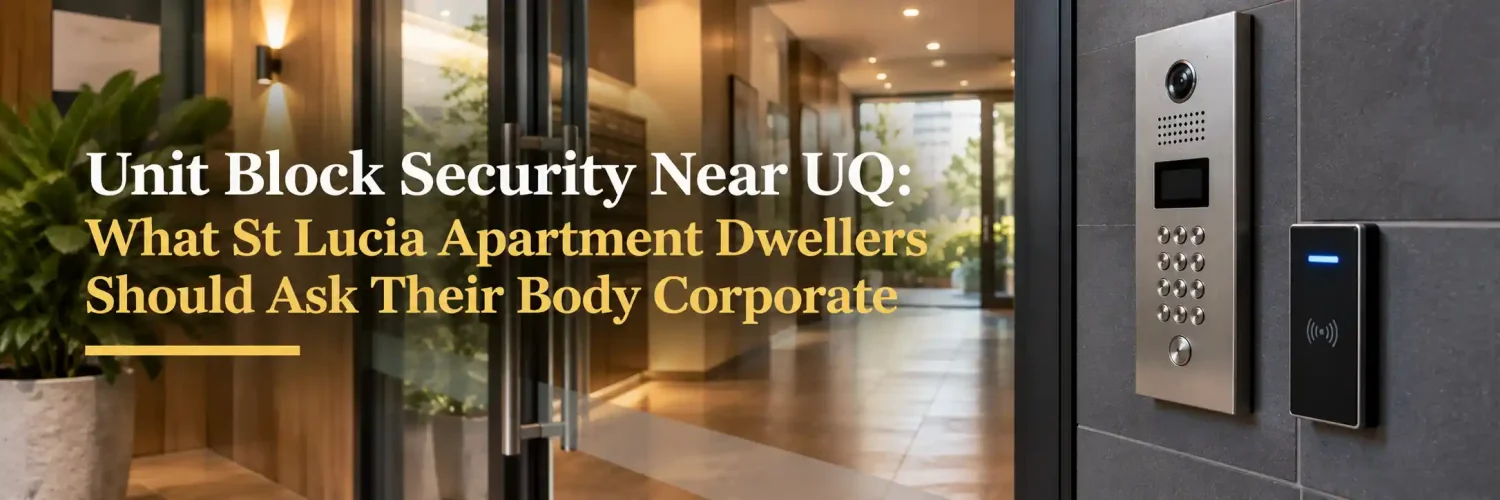
The apartment blocks within walking distance of UQ — along Hawken Drive, Macquarie Street, Sir Fred Schonell Drive, and the streets feeding the river precinct — represent a significant portion of St Lucia’s housing stock. For the students, academics, and local residents who live in these buildings, unit block security St Lucia body corporate arrangements create a shared responsibility that most residents don’t fully understand until they experience a gap in it.
Unit block security is a layered system where the body corporate manages common areas and the individual lot owner manages their own unit. These two layers interact in ways that aren’t always clear, and the body corporate’s decisions about shared infrastructure directly affect the security of every unit in the building — whether individual owners and tenants realise it or not.
How Security Responsibility is Divided in a Strata Building
In a Queensland strata-titled building, the body corporate is responsible for common property — everything outside the boundaries of individual lots. In a typical St Lucia apartment block, this includes:
- The building’s main entry, including the lobby door and any intercom system
- Lift access and stairwells
- Car park entry and common parking areas
- Bin rooms, storage areas, and other shared utility spaces
- The exterior of the building itself, including common-area windows and corridor lighting
Individual lot owners are responsible for their own unit — from the entry door boundary inward. This means the external face of your unit entry door may be common property (requiring body corporate approval to change) while the internal mechanism and the interior of the lock are your own to manage.
In practice, this means that the security of a St Lucia apartment depends simultaneously on two independent systems: what the body corporate has decided to implement for common areas, and what you have in your own unit. A strong lot door deadbolt doesn’t help if the building entry is routinely bypassed, and a well-managed building entry doesn’t compensate for a weak unit door lock.
The Building Entry: Your First Line of Questions
The building entry system — the mechanism that controls who can access the lobby, lifts, and corridors — is the security layer that affects every resident and receives the most inconsistent maintenance. For St Lucia apartments near UQ, the questions worth asking your body corporate or building manager:
- Does the building entry system require a fob, key, or PIN? Buildings that use freely-copyable keys for the main entry have effectively no controlled building access — anyone who’s ever had a key can return at any time.
- How are building fobs or cards managed when a tenant leaves? A fob deactivation process is only effective if it’s actually used. If the body corporate doesn’t have a record of which fobs are active, deactivation isn’t happening reliably.
- How does the intercom system work, and who can buzz entry? Buildings where pressing any unit button from the street opens the lobby door have no meaningful intercom control. The question is whether the intercom requires a specific unit to respond, and whether residents actually use it to verify visitors before granting access.
- When was the building entry system last assessed or upgraded? Older intercom and access control systems in St Lucia buildings may be using technology that’s well past its reliable service life.
Pro Tip:
If you’re moving into a St Lucia apartment block, ask the agent or building manager whether your access fob or card will be reprogrammed before you move in. In buildings with proper access management, a new resident receives a freshly activated credential, not one reissued from a previous tenant. If the building doesn’t actively manage this, treat your building access credential the same as a key with an unknown history.
Common Area Security Gaps That Affect Individual Units
The most common security weakness in St Lucia apartment buildings near UQ isn’t the front door lock — it’s the cumulative effect of small decisions and habits that erode common area security over time. As a resident, identifying and raising these with the body corporate is both your right and, in a practical sense, in your own interest.
Common patterns worth raising:
- Propped ground-floor exit doors — fire exit doors propped open for convenience (by delivery drivers, tradies, residents carrying groceries) defeat any building access control. If this happens regularly, it’s worth raising with the committee.
- Broken or non-functional lobby door closers — a lobby door that doesn’t fully close leaves the building accessible whenever someone passes. Building managers are responsible for maintaining these; a written report from a resident creates an obligation to respond.
- Car park entry used as an alternative building entry — residents or visitors who enter through an underground car park and walk up without using the building’s access control bypass the intercom entirely. If the car park-to-building door doesn’t have controlled access, this is a gap worth raising.
- Non-resident delivery and trade access — buildings that buzz tradespeople and delivery drivers in without visual verification are effectively operating on the assumption that anyone pressing a button is legitimate. This is a process question for the body corporate to address.
- Common area lighting failures — car parks, stairwells, and corridors with failed lighting are a security concern as well as a safety one. Lighting failures should be reported in writing to the building manager, not just noted.
Your Lot Entry Door: What the Body Corporate Controls and What You Control
The boundary between body corporate responsibility and your own is the entry door to your unit. In most St Lucia strata schemes:
- The external face of the door (what’s visible from the corridor) is common property. Changes to the external hardware — replacing the external escutcheon, adding a second visible lock — typically require body corporate approval.
- The internal mechanism — the deadbolt and lock cylinder — is generally your property to manage. Rekeying the cylinder doesn’t change the external appearance of the door and typically doesn’t require approval.
- The door itself — in many schemes, the door body is common property even though it’s within the lot’s nominal boundary. This affects what you can do structurally to the door without approval.
The practical implications:
- You can rekey your unit entry lock without body corporate approval in most schemes — it’s an internal mechanism change, not an external modification
- Adding a deadbolt where none exists, or a security chain, may require approval depending on whether the change affects the external door face
- Replacing the full lock set with a digital lock typically requires approval because it changes the external hardware profile
Check your specific scheme’s by-laws before any modification to the lot entry door. By-laws vary, and the lot boundary description in your scheme’s community management statement determines what’s lot property versus common property for your specific building.
Warning:
Don’t assume that because you own your apartment, you can make any change to the entry door without process. In strata, ownership of a lot doesn’t give you free rein over modifications that affect common property or the building’s appearance. An unapproved modification can result in a body corporate order to reverse it at your expense.
Questions to Bring to the Next Body Corporate Meeting
Body corporate AGMs and EGMs are the formal mechanism for raising security concerns that affect the whole building. As a lot owner, you have the right to submit motions and to receive written responses to written submissions. As a tenant, you can raise concerns through your landlord, who has standing as the lot owner.
Security questions worth raising formally:
- Is the building’s access fob or card system current, and when was it last reviewed for active credentials versus lapsed ones?
- What is the body corporate’s process for deactivating building access when a tenant leaves or a lot is sold?
- Has the building entry intercom been assessed for reliability and security recently, and is there a replacement or upgrade plan?
- Are all common-area lights functioning, and what is the maintenance schedule for replacing failed units?
- Does the body corporate have a current security assessment for the building, and is this reviewed periodically?
For Tenants: How to Raise Security Concerns Without Owning the Lot
If you’re renting rather than owning, your avenue for raising body corporate security concerns runs through your landlord. The practical steps:
- Document the concern clearly — what the issue is, where it is, when you noticed it, and why it’s a security concern
- Report it to your property manager in writing — email creates a record
- Ask the property manager to raise it with the lot owner, who can raise it with the body corporate
- Follow up if you don’t receive a response within a reasonable timeframe — a written maintenance request creates a response obligation
For urgent security issues — a broken building entry door, a lobby door that won’t close, a car park entry that’s been left open — contact the building manager directly as well as your property manager. Urgent issues don’t wait for the formal body corporate process.
Rekeying Your Unit in a St Lucia Apartment
For residents who’ve moved into a St Lucia apartment — whether as a buyer or a renter — the rekeying question applies just as it does in a house. The history of the key includes previous tenants, the property manager’s set, any inspection keys, and in buildings where the body corporate holds a master key, that too.
For renters: request rekeying in writing from the property manager. In most St Lucia apartment buildings, this is a routine request that’s handled by rekeying the lot entry cylinder without any building-wide impact.
For new owners: arrange rekeying as part of your settlement process. The previous owner’s key history is unknown, and a fresh cylinder gives you complete key control from day one. In some strata schemes, the body corporate holds a key to your unit — confirm this with the building manager and ensure they’re given a copy of the new key if this is the case.
Conclusion
Unit block security St Lucia apartments near UQ depends on two layers working well together — the body corporate’s management of common areas, and each lot owner’s management of their own entry and unit. When both layers are functioning, the building’s overall security is genuinely layered. When one fails, the other has to compensate for it.
The residents who experience security problems most often are the ones who treat these as someone else’s problem — assuming the body corporate is handling building security, assuming the previous tenant’s key history doesn’t matter, assuming the lobby door that’s been propped open for six months isn’t their concern to raise.
The residents who experience them least often are the ones who ask the right questions — about building access management, about their own lot entry, about common area maintenance — and raise concerns in writing when they find gaps. In a strata building, residents who engage with the body corporate process are the ones who shape the security decisions that affect their own home. That engagement is available to every lot owner, and accessible to every tenant through their landlord. Using it is the most direct way to improve the security of the building you live in.